

Cædmon’s Chronicle
Of How the Cowherd Became a Poet; An Alliterative Verse Narrative

Cædmon
Cædmon is (I say is and not was, for I believe it is a fact that the saints who have fallen asleep in Christ here on Earth are very much still alive with him in the heavenlies) a 7th century Anglo-Saxon cowherd, turned monk, who received the gift of word-smithing miraculously in a night vision. He is the oldest Anglo-Saxon poet we have written record of. His story is found in Bede’s Ecclesiastical History of England, and is only a few paragraphs in length - but what a story!
Having read several translations of his famous hymn (often simply called Cædmon’s Hymn - a version of which, in Old English, I have included at the end of this article), that don’t even attempt to maintain the meter in which it was originally composed, I long desired to write my own paraphrase. Then, once I began, I found that it demanded to be set within a larger poetic narrative, and, naturally, it had to be in Anglo-Saxon Alliterative Verse.
Before Reading
Some preamble seems to me to be required, for various reasons, before the main bulk of the poem. However, myself being the kind to skip most preambles (especially where poetry is concerned), I understand if you simply want to get on to the poem. Do not feel you must read this preamble at all, if that is you. Please feel free to skip the preamble below and get right to the good stuff. I won’t be offended.
A Brief Explanation of Form
Not that any good poem needs explanation - indeed, it is my conviction that great poetry should be accessible, and readable without one. However, as I am not in the habit of presuming that everyone is familiar with poetic meters which are not commonly taught in grade school (as the Anglo-Saxon style was not in mine), and considering the creative liberties I took with the meter in my own approximation of that great prosody (owing in part to my own ignorance, as well as my wont to find my own unique path), and not wanting those familiar with the style to be confused, nor the unfamiliar to unduly suppose that which is below to be representative of Anglo-Saxon verse in its purity - I have undertaken to give the following basic explanation of what Anglo-Saxon verse is, and then how mine differs.
Anglo-Saxon Verse
Anglo-Saxon verse is a primarily alliterative style of poetry, which was common to the medieval Germanic-speaking world (of which Old English is a part), and typified the Anglo-Saxon poetic unction.
The structure is fairly simple: it is comprised of any number of lines, with four beats per line (not counting syllables, as is the tendency in modern English poetry), divided into two half-lines which are linked by alliteration on either side, most frequently on beats one and three, though it could be on any of the others as well.
Another typical feature of Anglo-Saxon verse is the use of imaginative, two-word, compound metaphors, such as “sky-candle” in place of “sun.” (I admit, this is where my poem is at its weakest.)
My Variations
Now I put my ignorance on full display. At the outset, I had intended this project to be a true, traditional work of Anglo-Saxon verse, however, owing in no small part to it having been several years since I’ve written anything long-form - let alone Anglo-Saxon - and that I failed to refresh my memory concerning the structure of that which I put myself to build prior to the undertaking, I completely botched the four-beats-per-line structure, core to the prosody in question. Instead, I opted to count syllables - as one really oughtn’t do with this form of verse - ensuring I had no more than eight, and no less than five syllables per half line, preferring seven wherever possible. This meant considerably more beats per line, in many cases, than the standard, with some of my half-lines being as long as a full line in the traditional form!
Of course, I realized my error only after I had completed my full narrative. And, not being too much a perfectionist, and with Time being a limited resource, and having no desire whatever to rewrite my entire manuscript (what with having many other projects I wish to attend to before I’m very much older, among other reasons), I have decided to leave it as it is. (I did begin to attempt this, but quickly abandoned the idea. Perhaps one day I’ll revisit it, but for now, I’ll let it stand.)
Two things I did do intentionally:
I chose to alliterate, not primarily upon the beginnings of words (as is most common), but rather on stressed syllables. I did this for the sake of more closely adhering to the naturally iambic structure of modern English speech, for often the stressed syllable in a word is actually the second. So if the words reposed and robin traditionally alliterate, I preferred to alliterate reposed and prayer, for the stressed syllable in the former matches the stressed syllable in the latter. You will hear it better in the poem if you read it aloud, or listen to the voice-over I have provided.
My final variation is one of visual form. Anglo-Saxon verse is not written in stanzas, as modern poems tend toward, but rather line-by-line, with a physical break in the line between beats two and three as a visual cue to the reader. However, this can create some awfully long lines which are hard to read on today’s most common medium for reading such things: the cell phone screen. This in consideration, I chose to break my lines vertically, rather than horizontally, indenting the second half. So if the first line of my poem would traditionally look like this,
Cædmon was a cowherd, clothéd roughly, poor and humble …
in my structure, it looks like this,
Cædmon was a cowherd
    clothéd roughly, poor and humble …
This allows for the visual cue to be maintained while allowing for an easier read on all devices.
I also chose to break the poem into stanzas consisting of four full, and one half line each, for visual appeal. The extra half-line is there on a whim, as the stanzas felt incomplete without them.
There is my explanation - an apology, if you will. Call this an Anglo-Saxon/iambic/stanzaic fusion, or, if you like, an Anglo-Birchian verse.
One Final Note
Anglo-Saxon alliterative verse is generally performative, and meant to be listened to. I highly encourage you to either read this aloud, or listen to my voice-over.
Now, without any further confounding preamble, on to the tale!
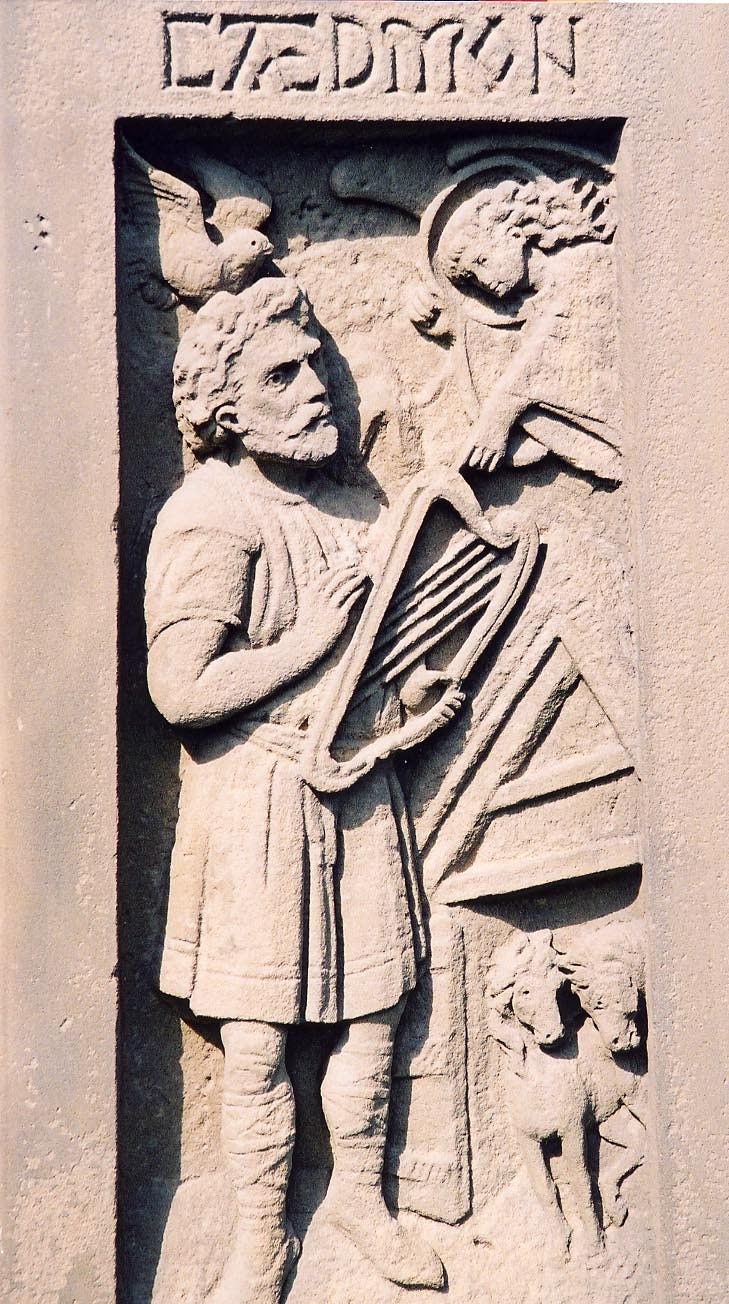
Cædmon’s Chronicle
Cædmon was a cowherd
    clothéd roughly, poor and humble;
as home, Northumbria, he hailed
    where Hilda, Streoneshalh’s abbess held
high charge of holy life.

Free were the days, when the Light first
    fell full on English eyes -
ever lifting minds and hearts
    to Highest Heaven‘s greatest gift,
given to ransom Adam’s race.

Days were they of burgeoning dawn,
    when dragons fell to Christian swords -
sworn enemies, they, of all
    evil beasts of dark abode -
so bright their hope, their blazing faith!

Now Oswiu ruled as heir
    on the Angle throne (after
Oswald, blessed king, fell to Penda -
    praying with his final breath,
bent o’er the souls of his men),

when the Saint there walk’d,
    wandering to and fro -
through fields of shire-green
    grown on ocean’s breath -
blithe were those days, and the stars sang!

And Cædmon was become,
    crowned with grey already,
ripened in his years -
   yet not at all withered -
when we join in his tale,

in Streoneshalh’s seaward streets,
    strolling port-town paths,
its people his neighbours - friends
    formed together in bonds
born of shared communion;

collective labours lay
    light on many shoulders,
sharing both lack and plenty,
    pious shriving, pleasant resting -
the rite of wassailing also:

e’er at times of feasting, when all
    able persons, by their custom,
came to dine and gather -
    gifting each their presence,
profiting each the other -

when filled the hall, and fire
    fuelled and lit the hearth,
and hearts were warm’d and merry,
    mingling mead and laughter -
listen’d, they, to each other.

Then passed the lyre from person
    to person, each to play,
pluck a tune, and lay to sing -
    subtle craft of verse -
vibrant poetry.

The agéd sang songs of old -
    those oft recited, rarely written
rhymes of ancient pagan gods
    gathered together for their judgement,
justly condemned - doomed to fire.

Those mature would chant through
    the thrum of faithful-living days -
dawn to dusk, and through the night -
    nought but done in love and grace -
grateful hearts for mirth and toil.

The mouths of youth in chorus mingled
    merry tunes of midnight dances -
dauntless men and maidens fair
    frolicking in lovers’ rites -
revelry their wont and passion.

So the harp wound its circuit,
    straying not ‘til each had played,
poem performed or else a tale
    told, delighting every ear -
of all sitting present.

But Cædmon sang no canticle,
    kept close his eye on the harp.
To hail the crowd, and chant a verse,
    his voice could never bear -
Better to bid goodnight, ere then -

mud-minded, with muck-melody,
    no might with harp or lyre -
little skilled in word and verse-craft -
    verily he judged himself,
his silence keeping, in the hall.

‘Twas, late upon an eve the like,
    when left the saint from feasting,
for fear to be embarrassed;
    he brought himself to the cowshed -
the cattle’s weather-shelter.

Ever there he found his ease -
    his eyes knew the spots of each,
his ears the every subtle
    sound of the lowing beasts -
bovinish speech - their poetry.

Arranging himself there aright,
    ready then to take his slumber,
the saint sighed a silent prayer
    for peaceful rest and pleasant dreams -
and dream he did, anon.

“Cædmon!” the voice came,
    calling out his Christian name.
Never had the saint heard
    a heavenly voice so sweet -
it swelled like bells and laughter.

“Cædmon!” came again the call,
    to claim the saint’s attention.
Turning thither, he saw a man
    mantled in white shimmer -
shining silver hues.

“Here am I,” said he
    his head lifting, limbs rousing -
ready heart to receive
    a solemn charge or warning -
waiting for the man’s word.

“Start, brother,” the man said
    “to sing to me a song.
“sing that I may in turn
    “take delight in hearing
“a hymn worthy of Heaven!”

He, troubled in spirit, heaved
    a heavy sigh, and said,
“Sing, I cannot - skilled not am I.
    “If ever I open my mouth
“it makes the most wretched sounds!”

“Fro I went from the feast,
    “for this reason, early:
“that I might not embarrass
    “both myself and list’ners,
“Languish’d by my screech-tongue!”

The man remained, unmoved,
    mirthful gaze glinting -
gracious tongue speaking -
    “Such as may be be, still
“sing for me, my brother!”

Cædmon, trusty cattleman,
    calmed within that gaze,
gathered up his musings,
    His mouth then spake a word:
“Of what shall I make melody?”

Said the bright-clad man, “Sing
    “a song concerning the first
“founding works of creation,
    “when all that’s Lovely became
“crafted within the Word.”

Embolden, forth he brought
    beauty of boundless heavens,
and hope of Earth’s glory.
    He gave his tongue to sing -
the saint, this song he wrought:

   “ Now we must magnify
        the Master of Heaven’s kingdom,
    the Crafter’s might
        and his mind’s will -
    the works of the Glory-Father
        for his every wonder,
    which th’Eternal Lord
        long ago founded:
    he fashioned first a home,
        for humans to inhabit,
    the Holy Craftsman shaped
        the shining heavens to cover,
    to crown this Middle Earth.
        Aft’ward, mankind’s Keeper -
    King Eternal - ordained
        a dwelling on land for men.
    Almighty is the Lord! “

Sang the saint with such
    subtle, beauteous voice,
and verse so heav’nly crafted,
    Cædmon marveled himself -
so sudden his transformation!

Indeed, no poem since that day’s
    been deemed e’er to equal -
been claimed e’er to rival -
    the rune that cowherd wrote -
th’aria of Creation!

‘Twas said that ever since,
    the saint continued always
in this gift of poetry -
    and pleas’d was Hilda to make
a monk of him, in the monast’ry,

where he made it his wont,
    when he heard Holy Scriptures,
to set them into verse -
    veritas and beauty,
bound in son’rous song.

Lived he there until his last
    Life’s-Breath left his Mortal Frame;
from friends, received unction -
    Eucharist he partook of -
to Triune God, himself committed.

And so ends the story -
    the saint’s tale, truly told.
And Time shall remember,
    of this master verse-maker,
‘twas th’ Makers’s gift - the Master’s grace.

And christened, called, humble Cædmon
    came into his heav’nly home,
hailed not as cattleman -
    acclaimed higher than poet -
in priestly garments clothéd;

Saw he the Father in Heaven -
    beheld that Glory-Haven,
Where heroes, saintly, dwell.
    He heard that hail ‘yond Light of Dawn:
“Well done, my faithful servant!”
Cædmon’s Original Hymn In Old English (or Anglo-Saxon)
nú sculan herían    heofonríces weard
meotodes meahte    and hís módgebanc,
weorc wuldorfæder,    swá hé wundra ġehwæs,
eče drihten,    ór onstealde.
hé ærest sceóp    íelda bearnum
heofon to hrófe,    halíg scyppend;
þá middangeard    moncýnnes weard,
eče drihten,    æfter téode
fírum foldan    fréa ælmihtig
Thanks for reading! Wæs þu hāl!
Well done, Alexander! Caedmon comes across as being shy, sweet, and earnest :) I enjoyed that very much!
This was lovely!!